Generations of educators will shoulder the responsibility of the U.S. Bombing of Laos during the American Secret War

From the desk of Stephen White, Emeritus Board member, Legacies of War

As an American educator, when I accepted a leadership role at an international school in Laos, I never imagined that part of my responsibility would include teaching children about the dangers posed by American bombs still buried in their communities. Seeking to better understand this reality, I joined the Board of Directors of Legacies of War and committed to learning directly from the work being done in Laos.
In Laos, one of the most devastating legacies of U.S. bombing during America’s Secret War is that an estimated 30 percent of the more than 2.5 million tons of explosive ordnance dropped failed to detonate and remains embedded in the land. Tens of millions of explosive remnants still lie hidden in riverbanks, rice fields, forests, and schoolyards across the country. The consequences are ongoing and tragic: national authorities report that more than 60 percent of recent unexploded ordnance (UXO) casualties are children, many injured after mistaking small cluster bomblets for toys or scrap metal. This includes five children who were recently injured after contact with an unexploded ordnance in November of last year.
My commitment to learning more took me to Phonsavanh, in Xieng Khouang Province, in November of 2025, where I joined a Legacies of War delegation to one of the most heavily bombed regions of Laos. There, I visited an active UXO clearance site and observed a school-based Explosive Ordnance Risk Education (EORE) workshop at a local primary school. Seeing both the physical removal of unexploded bombs and the educational response side by side revealed how national policy translates into lived experience.

The most sobering moment came when we were told that the school’s soccer field had been cleared of UXO just two years earlier—50 years after the bombing ended. For generations, students and teachers at this school have lived with the emotional toll of restricted play, constant vigilance, and the stress of knowing their schoolyard was contaminated.

Why Laos Offers a Blueprint
To survive this reality, Laos has built a national strategy centered on risk education. This strategy is rooted in partnerships between government schools and private organizations that apply principles of child development to deliver life-saving messages in communities most affected by UXO, such as Phonsavanh.
National environmental textbooks introduce developmentally appropriate lessons beginning in grade two, teaching children how to benefit from Laos’s fertile land while also understanding practices that support public health and personal safety. This contextual approach allows children to see UXO education not as an abstract danger, but as part of their environment. The same environment that provides for them is also where the risk exists, and we must ensure students are informed and able to navigate these complexities safely and confidently.
These lessons are proven to save lives. A recent Instagram post from MAG (Mine Advisory Group) shared an example of students who had participated in a UXO risk prevention program. When they came across a munition, they correctly identified it and, using what they had learned, avoided touching it and reported its location to the proper authorities.
This real-life example shows why it is so important that students learn and revisit these skills. This learning is revisited throughout primary school with increasing depth and detail. Private organizations (like MAG) reinforce these lessons through storytelling, songs, and group activities, creating engaging and memorable learning experiences.
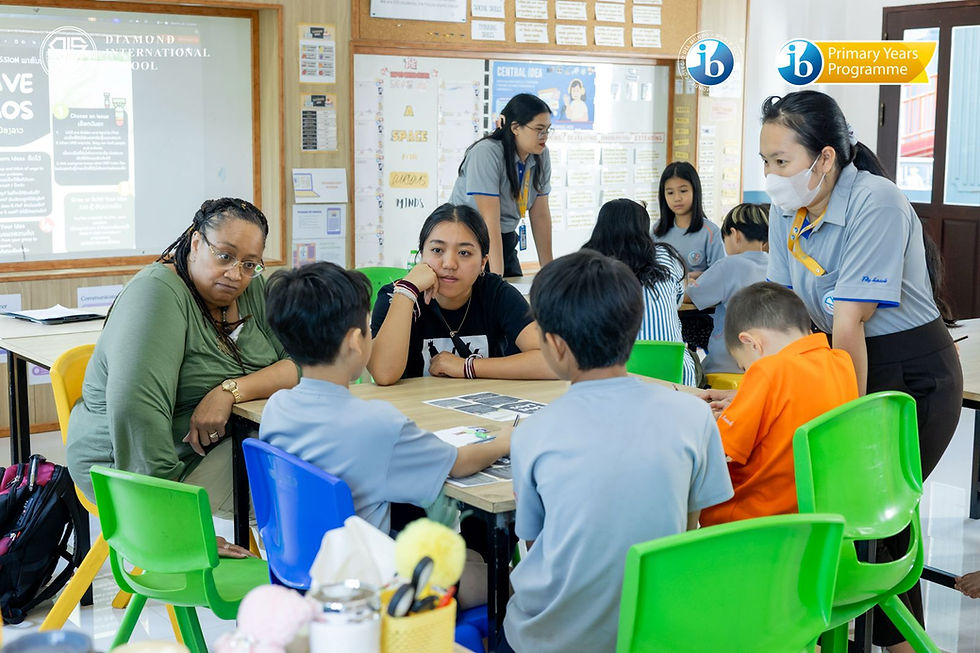
Working in schools, I am continually struck by the insight and critical thinking children demonstrate when given information and agency to address the challenges facing their communities. This is what I witnessed recently, during a roundtable discussion hosted by Legacies of War’s Titus and Linda Peachey Peace Fellow, Jewelry Keodara, with Grade 4 students at my school, one student made a powerful connection: UXO is not only a safety issue for individuals, but also a community issue that can be addressed through access to quality health care when people are injured.

A Long-Term Responsibility for the World
Laos’s national approach to Explosive Ordnance Risk Education, supported by partnerships with civil society, represents a meaningful step toward reducing UXO accidents. Yet the reality is clear: the timeline for fully clearing UXO in Laos stretches far into the future. Generations of educators will continue to shoulder this responsibility.
For this reason, global solidarity is essential. International support must continue as Lao officials, teachers, and community workers work tirelessly to prepare children to live safely in a contaminated environment. Laos’s leadership in this field will be further recognized when it hosts the 3rd Review Conference of the Convention on Cluster Munitions in September 2026, underscoring its role as a global leader in UXO education and advocacy.
When schools are bombed in Gaza, Iran, Lebanon, Ukraine and beyond— it is teachers who find themselves facing the same responsibility Lao teachers have carried for decades. It is time for the global community to listen to these educational professionals, respond to their needs, and recognize that education, health care, and safety are inseparable in places where war has not truly ended.
The U.S./Israel war in Iran is unfolding in ways that echo patterns we recognize from the U.S. Secret War in Laos. The U.S. bombing of schools such as Shajarah Tayyebeh Elementary in Iran forces generations of teachers and students to navigate a reality not unlike that faced by many schools in Laos that were once subjected to U.S. bombing campaigns.
For teachers, this means education cannot focus only on literacy and numeracy. It must also help students connect with war survivors so they can understand the history and ongoing danger beneath their feet. As Allie Hansen, Legacies Advocacy Ambassador, reminds us, we must seek out and preserve the stories held by war survivors before this history—and the essential context it provides for understanding present-day risks—is lost.
In a recent piece for the Center for International Policy Legacies Advocacy Ambassador, Allie Hansen, highlights how Organizations such as Legacies of War play a critical role in bridging that gap through collecting the stories of survivor testimony through the Legacies of War Library, piloting educational programs in the US and in Laos and engaging congress to support UXO demining.
The legacy of unexploded bombs is not only a humanitarian crisis — it is a generational responsibility for educators that policymakers must resource by elevating the testimony of war survivors. My time in Phonsavanh, standing on land that had only recently been cleared and watching children learn how to stay safe through school-based EORE workshops, made this truth impossible to look away from. Policymakers must listen to survivor testimony, recognize the ongoing risks faced by subsequent generations, and commit to sustained funding for clearance and risk-education programs.


