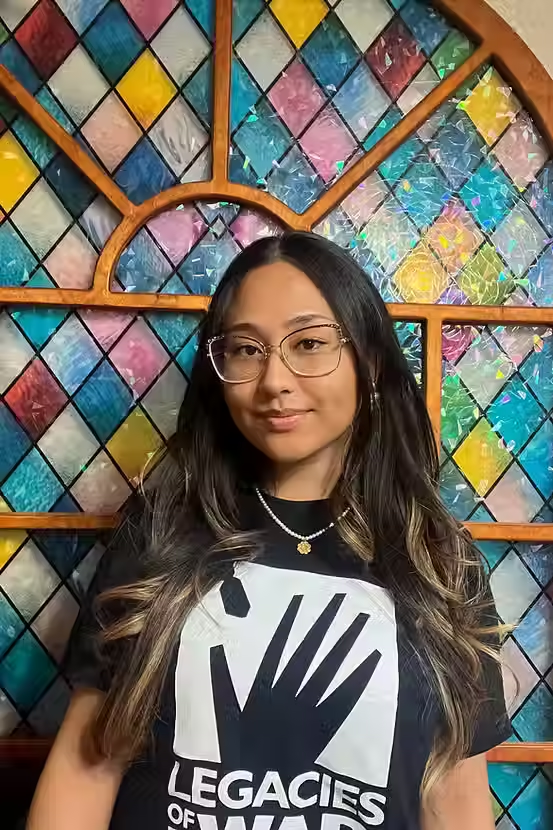
The Courage to Question

From the desk of Alexandra Hansen, Legacies Advocacy Ambassador
Growing up south of Houston, Texas, I was surrounded by an infectious enthusiasm for innovation. My father was a career engineer at NASA, and has contributed to many incredible innovations that have sent men and women (some who were parents of my high school classmates) into orbit. I have always been thrilled by the belief that even the toughest challenges can be overcome with a team and a shared vision. I followed in my father’s footsteps, pursuing mechanical engineering at university.
The summer before my senior year of college, I got a serendipitous opportunity to spend the summer in Cambodia, interning with a small company called Cushybots who were designing an explosive ordnance disposal (EOD) robot. To this day, I can attribute my career shift to the wonderful humans at the Center for Humanitarian Engineering and International Development at Villanova who gave me the opportunity.

The U.S. dropped over 2.7 million tons of explosives on Cambodia during its involvement in the so-called “Vietnam War” from 1965-1973. For all military explosives used during this time period, between 10-30% malfunction and remain as unexploded ordnance (UXO) after the war. Today, UXO is washing up on riverbanks, constricting the use of farmland, and making it unsafe to walk on uncharted paths. I spent the summer working with students and local engineers to design a robot that could safely inspect and remove explosive ordnance left from conflict over five decades before, many of which originate from the United States’ eight-year bombardment on Cambodia.
I learned about sourcing materials locally and affordably, and how to design to satisfy the needs of our nonprofit stakeholders. Most importantly, I was immersed in the culture of living with remnants of war that still haunt communities in Cambodia and the resilient humans working relentlessly to change that.

I visited the Tuol Sleng Genocide Museum in Phnom Penh, a site where over 12,000 people were tortured and murdered by the Khmer Rouge during the Cambodian Genocide from 1975-1979. I was given a tour by the daughter of one of the few survivors of the prison, who volunteered her time to share her mother’s story. The damage caused by the United States’ war crimes in Cambodia is widely considered the main factor that led to the Cambodian Genocide.

I found inspiration in the innovation that I witnessed by demining groups in Cambodia. I visited the center of APOPO, a nonprofit that trains African giant pouched rats to detect landmines buried underground. The rats are trained to detect the explosive material that exists inside all types of explosive weapons, something that technology has never been able to achieve. APOPO’s rats have cleared over 100 million square meters of former minefields for safe use in Cambodia.

We visited Golden West Humanitarian Foundation’s center in the Kampong Chhnang Province, where they work with the Cambodian Mine Action Centre (CMAC) to recycle the explosive material in ordnance into charges used to safely detonate others. I witnessed a controlled detonation, where a charge was used to detonate ordnance found by CMAC. As we sat behind a concrete barrier, I felt the explosives shudder the ground beneath us. For the next minute after the explosion, small whooshes could be heard, made by the shrapnel from the explosion. I reflected on the courage Cambodian farmers must have to risk these explosions to feed their families, a choice nobody should have to make.


At first, the new perspective I had gained from my trip to Cambodia was disorienting. During the first week of my senior year of college, I attended an engineering career fair, only to see the booths with the longest lines be companies that manufacture weapons like the ones I saw at the detonation with Golden West, and that I heard from Cambodians at the Tuol Sleng museum. How could I have spent so many hours building my tolerance for tough problems, refining my ability to think creatively, and forgotten to look at the effects of what I was being trained to build? In response to questioning, I often heard:
“It’s not your job.”
“That’s just politics.”
“What other option do we have?”
As an American, it is easy to be divorced from your relationship to the world. We are told that we are the center of the universe, that we have the most knowledge and the best skills, and that anyone would want to be in our position. It is also easy to be disconnected from your work, to assume that it will all be put to good use. Many engineers I know are initially inspired to pursue STEM because of its power to shape the world around them for the better, then lose sight of what their contribution to humanity is after graduating. It’s easy to follow this path in the sheltered industry of the United States. The people I met and the stories I heard in Cambodia flipped my ignorance on its head.
These stories laid the foundation for me to expand my meaning of critical thinking. The more fundamental problem came into focus. I have no doubt that technological innovation will continue. The stickier, more uncomfortable question is this: Will technology be used to uplift, or will it continue acting as a barrier to peace?
I turned to pursue a career in policy and advocacy, focusing on progressive arms control. As a former engineer who understands the cultural challenges that exist in the United States’ military industrial base, I am looking to build a coalition of people from all backgrounds who are interested in centering human life and dignity in all that they do.
I am not naïve enough to say that I know the answer moving forward. All I know is that I was taught as an engineer to have the courage to question, so I will continue to question. I am taking this lesson and choosing to focus my energy on people. On our culpability for the horrors currently being committed in Palestine, Sudan, and the Congo. On stories like the ones I heard in Cambodia, and like the ones Legacies of War centers in their advocacy.
As the creators of the world as we know it, engineers and other STEM professionals have immense power. And with power comes a responsibility to open our eyes. To ask the tough questions, even if it makes us uncomfortable. Even if it defies the clean-cut version of our place in the world that we were always taught. Many of us went into engineering because we wanted to be helpers, and I am calling on us to hold ourselves to that standard.
With love and gratitude,
Allie Hansen