Leaving Laos, I Carry More Than Memories

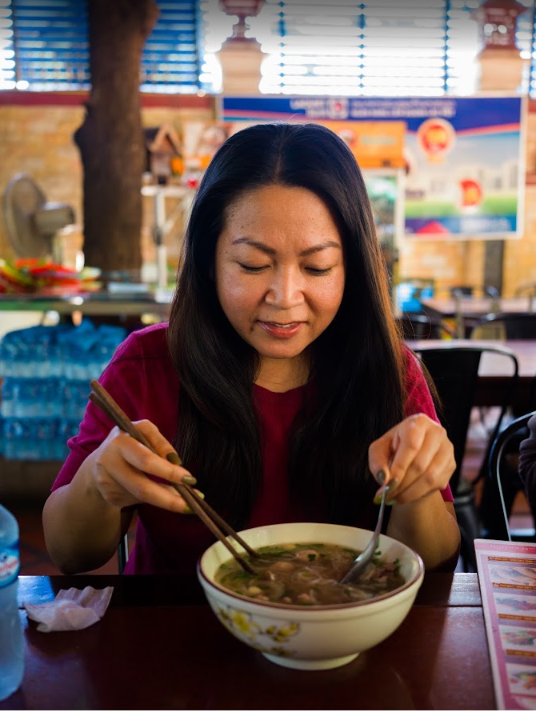
From the desk of: Jewelry Pouna Keodara, 2025 Titus and Linda Peachey Peace Fellow, Advocacy Ambassador, Legacies of War
We often grow up hearing stories from our parents and loved ones about lifetimes before our own, tales that blur truth and myth. Crossing rivers, trekking through jungles to school—each story shaped by the eyes that tell it. As a young girl, I heard tales of war from my family's homeland, but I could not grasp their meaning. During childhood summers, I visited Laos, exploring villages, markets, and schools. I loved learning about my culture, yet the real history of the land remained invisible to me. It wasn’t until I became an adult that I began to understand its full weight.

My name is Jewelry Pouna Keodara. I am a Lao American, born and raised in Urbana, Illinois, the daughter of parents who migrated to the United States from Laos after the war. I was honored to be named a 2025–2026 recipient of the Titus and Linda Peachey Peace Fellowship, a Legacies of War program that pays tribute to the Peacheys’ decades of dedication to addressing the lasting wounds of war in Laos and advancing peace, justice, and prevention. Being part of this fellowship was both an incredible privilege and a humbling responsibility, and I carried a deep sense of connection and humility with me as we began our journey into Laos.
Over the course of two weeks, I had the remarkable opportunity to travel with Legacies of War to Laos and Vietnam. During this time, we explored schools, communities, and historical sites, witnessing firsthand the lasting impact of war on people who had no choice in its consequences. Being Lao, I carried with me both my family’s experiences and the shared history of my community; being American, I also carried the awareness of a history in which the country I now call home played a part. This journey deepened my understanding that peace is not abstract, but is built through courage, care, and persistent action, and it reinforced my commitment to advocating for safety, healing, and opportunity for those whose voices are too often overlooked.
Our first stop was Xieng Khouang, a small province nestled among mountains and winding roads. From above, it looked peaceful. On the ground, roads were dry and sandy, shops were small, and the people among the friendliest I had ever met. At first glance, the legacy of the American Secret War was invisible, but look closely, and Explosive Remnants of War (ERW) repurposed as props, bomb identification posters on houses, and other subtle signs revealed a city still living in the shadow of a deadly past, where danger is not just history, but a part of daily life and an uncertain future.

On our first day in the city, we visited a local school where students were learning about Explosive Ordnance Risk Education (EORE) with Mines Advisory Group (MAG). The classrooms were small and worn, with faded, cracked walls, dusty floors, and barely standing desks. It felt familiar, like the schools my parents had described from their childhood. Stepping inside, children pressed close to the doors, whispering, waving, and curious and excited by our presence. The room smelled faintly of chalk and dust. As the EORE presentation began, the atmosphere shifted. We watched as the children sang songs about staying safe from bombs, watched a cartoon about UXO, completed worksheets, and shared what they would do if they ever found any, practicing the steps that could save their lives.
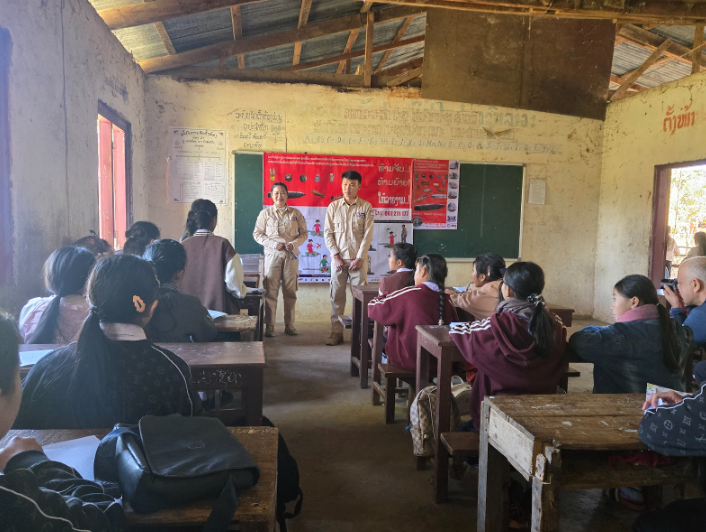
At that moment, I felt a heavy weight in my chest. This wasn’t a lesson in reading or math; it was a lesson in survival. Children no older than fourteen were learning to navigate danger in a world that should have been safe. As if life weren’t hard enough, they faced the same hardships my parents had, with the added, ever-present danger of unexploded ordnance.
Following the school visit, we traveled to a farm less than thirty minutes from Phonsavan, where a MAG clearance team had been called to remove bombs recently discovered by a villager. We hiked up a steep, grassy path with patches of dried dirt to reach the site. The bombs were packed with sandbags along a path that people and animals used every day, not knowing the danger beneath their feet.
From the top of the hill, the view was incredible. Jagged mountains stretched across the distance, and fields below spread out in shades of green, gold, and brown, like a patchwork quilt. Small villages rested quietly in the valleys. The team explained the careful process in which they worked. Then the former MCC country directors that were part of our delegation, some of the very people who had laid the foundation for UXO clearance in Laos fifty years ago, stepped forward to press the button.
After a tense countdown, the bombs detonated. The ground shook as clouds of dust lifted over the hills. Watching the directors in that moment was surreal, seeing decades of work and dedication come full circle. When it was over, the words that followed were, “Yay, three out of 80 million to go.” For a brief moment, there was relief knowing some bombs were gone, but at the same time, it felt like we were only getting started. I was seeing a full circle moment, but also the reality that this was only one small step in a much longer journey.

After seeing the explosion, my mind went back to a conversation I had with my grandfather a few weeks before the trip. I had asked him to share his experiences as a soldier in another town in Laos, Savannakhet, still deeply marked by the war. He described vividly the sight of the bombs falling and warned me what to expect. I asked if the explosions had scared him at first. He said yes, but after the first one, you become numb; it all just becomes noise. Standing there, feeling the ground shake and the smoke fill our lungs, I realized I was only experiencing a fraction of the fear he must have lived with.
The next day, we visited Tham Piew Cave, where 374 civilians had been killed when an American rocket strike collapsed the shelter. Walking through the site, my stomach sank under the weight of the tragedy. Shadows and crevices seemed to hold the panic and desperation of those trapped inside. My grandfather had told stories of people hiding in caves to survive, but standing there, I felt it in a way the stories never captured: the darkness, the helplessness, the terror. It wasn’t just history; it was real, one of countless places where the war’s consequences still lingered.
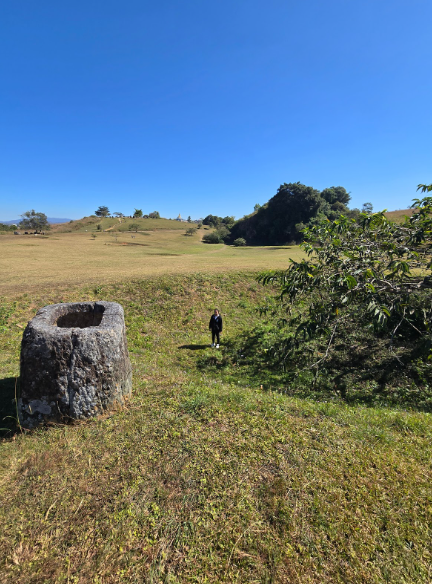
Not long after, we visited the Plain of Jars, a landscape scarred with bomb craters and trenches. Trying to imagine the experience through my grandfather’s eyes, with planes overhead, bombs falling like rain, and people diving for cover, I felt a knot of fear, though it was nothing compared to what he endured. Every crater and scar in the earth bore witness to the senseless violence and tragedy of war. Suddenly, his stories weren’t just stories anymore; they were alive in the land, a silent testament to lives forever changed.
Yet amid devastation, we also witnessed strength and possibility. In Phonsavan, we visited Lone Buffalo School, a center that teaches young people to take initiative and build entrepreneurial skills so they can thrive despite uncertainty. The students were bright, curious, and full of ideas, their optimism a stark contrast to the destruction in the bomb fields. At both schools we visited, what stayed with me was the students’ excitement when they learned that I was Lao American. Their reaction revealed how powerful representation can be in places where opportunities for women are limited. It wasn’t about me; it was about the possibilities they saw for themselves.
This realization grew as we traveled to Vientiane and Hanoi, meeting organizations clearing UXO and making communities safer. The remarkable pattern was clear: those leading the work: the coordinators, trainers, program leads, advocates were overwhelmingly women.
Even amid the inspiring work, the truth of the war was impossible to ignore. This wasn’t like the history we read in books or hear in stories whose truth we can’t verify. In Laos, the evidence was everywhere: the soccer field at the rural Phonsavan school we visited, built after bombs were cleared in 2024; the farmland we saw still dotted with cluster bombs along paths a family uses daily; the report that five children had been injured that very day in another city by UXO found in a field while searching for crabs; massive craters across the Plain of Jars; and repurposed bomb shells outside homes and shops. These dangers exist in spaces people use every day. The danger wasn’t history or something from a movie: it was present, real, and urgent.
Leaving Laos, I carried more than memories. The stories I once heard as a child now had names, faces, and places. Even amid the weight of what I witnessed, hope remained present in classrooms, community meetings, and in the women leading change. During our school visits in Vientiane, young children asked if the bombs would ever be fully cleared. I did not know how to answer them, but their voices followed me home. Though the answers remain unknown, what is clear is that the future begins with what we choose to do today. Every step, every life touched, matters not for certainty, but for possibility. A history revealed, a legacy I carry forward, and a hope that will outlive me—moving through generations unseen, but never untouched.