The Rhythm of Our Shared Survival

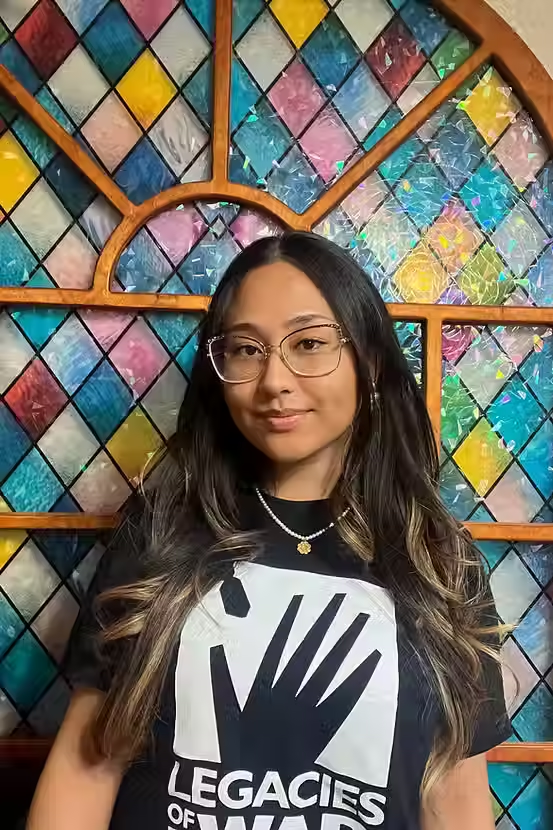
From the desk of Sera Koulabdara, CEO, Legacies of War and Fellow, Class of 2025-2026, U.S.-Japan Leadership Program

There is a rhythm to survival, a heartbeat that pulses long after the bombs have stopped falling. Today, August 19th, World Humanitarian Day, I find myself reflecting on the dark hollow that follows conflict, and the inextricable ways we are tethered together across oceans, generations, and frontlines.
That interconnectedness was brought into focus for me last month when I attended the U.S.-Japan Leadership Program gathering in Palo Alto, California. I was struck by a wave of overwhelming gratitude when I heard the story of two remarkable humanitarians: PJ (Patti Jo) and Roy Hirabayashi.
In 1968 and 1969, as PJ and Roy were graduating from high school, the world was fracturing. The civil rights movement was at its peak, and protests against the American war in Vietnam and the broader U.S. secret bombings in Southeast Asia were sweeping the nation. These two young people—third-generation Japanese Americans whose own families carried the scars of racism, injustice, and the trauma of internment camps—made a choice. While fighting for their own place and dignity in this country, they also raised their voices for strangers across the ocean protesting a war that was devastating lands they had never seen.
Across that very ocean, my teenage parents were living through the terror of that exact war. From 1964 to 1973, the U.S. secretly dropped at least 2.5 million tons of ordnance on Laos during 580,000 bombing missions, making it the most bombed country per capita in human history. Today, millions of unexploded bombs remain, impacting about one-fourth of Laos and posing a deadly threat to children and their families.
Meeting PJ and Roy over fifty years later, I realized that had they not spoken up and joined the chorus of brave anti-war voices, the bombing and the fighting might have stretched on even longer. My parents’ lives might not have been saved. The sheer existence of my family today is linked to courage like theirs. They were a vital part of the collective force that helped stop the killing, allowing a future where I could eventually stand before them.
After they shared their story, PJ and Roy played the Japanese Taiko drum for us. Watching them strike the drums, it was clear this was about so much more than music. Through the resonant power of this cultural art form, they were reclaiming a heritage with their strength and honoring their roots.

It immediately brought me back to my own lineage. In our Buddhist culture, before we begin a prayer ceremony, we also strike a gong. For us, hitting the drum is a physical and spiritual call to the soul. It is a way of bringing our spiritual essence back to our bodies, anchoring us in peace so that we can be wholly present. In that space, the Taiko and the Buddhist drum merged as one heartbeat for me. They were hitting their drums to call back their ancestral roots; I recognized the sound as the call that brings the soul back home.
This act of revival is the very foundation that guides our mission at Legacies of War, which addresses the enduring impact of conflict through advocating for U.S. funds to support humanitarian demining, survivor assistance, and explosive ordnance risk education. A twin pillar of this work is our educational initiatives, including Legacies Library, which serves as the keeper of The Originals, the only primary sourced documentation written or drawn by refugees who were fleeing the bombings in Laos firsthand. The drawings and narratives represent those, like my parents, who endured an air war perpetuated in secrecy.

Spiritual retrieval is difficult when new wounds are actively being inflicted. We cannot honor the survivors of the past while turning away from the frightening skies of today.
Last year, my colleagues and I traveled to 23 cities in Ukraine. What I witnessed was more than scorched fields or shattered silos. It was the unassuming valor and endurance etched into the faces of people who refuse to be broken. Driving through the Ukrainian countryside, we were awestruck by the beauty around us—sunflowers stretching to the horizon and wildflowers dancing beneath impossibly blue skies. For a moment, we could almost forget we were in a warzone.

Yet the reminders were always present. From Kyiv west to Lviv, we passed roadside shrines, graveyards, and memorials.

The devastation there was immediate; it was breathing, bleeding, pleading to be healed. That same agonizing heartbreak echoes in the present moment as we witness the current U.S. bombings in Iran on civilian targets like the airstrike on Shajareh Tayyiba Elementary, a girls’ school killing more than 100 children. We cannot speak of our collective conscience while turning away from the ashes of a place where young girls were meant to learn, dream, and shape their futures.
The actions we take, no matter how seemingly small, ripple across the world. What happens to one of us happens to all of us. When PJ and Roy marched for peace decades ago, they were marching for my family. Today, when the drum beats, it beats for the families in Iran, the children in Ukraine, and every community shattered by violence. It calls us back to protect our shared humanity, reminding us that we are, and always have been, powerfully connected.