A Peak Into My Life as a Lao American

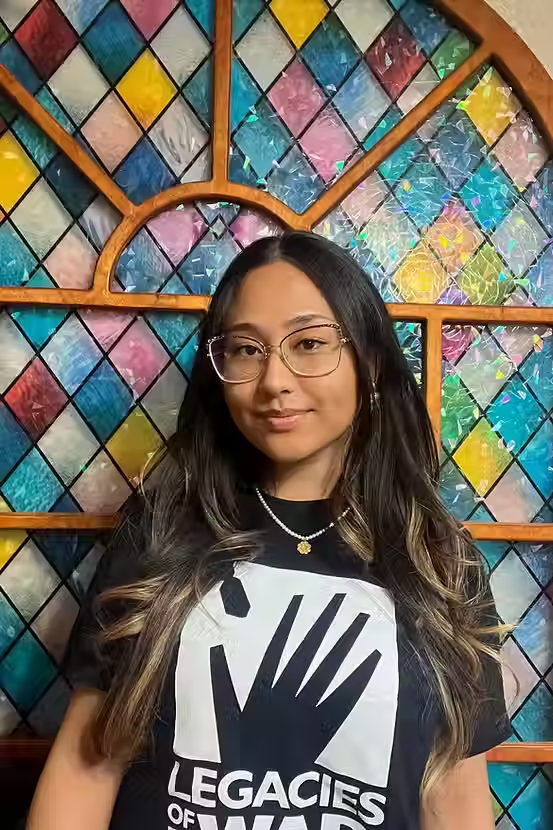
From the desk of: Allie Soisouvanh Price, Advocacy Ambassador, Legacies of War

My name is Allie Soisouvanh Price. I am a financial aid administrator at a college in Washington DC, a proud Legacies of War Advocacy Ambassador, a historian, and a storyteller. Most importantly, I am the daughter of Lao refugees. Here is my story about where I came from and what I stand for.
I was born in Chicago, Illinois. I spent my childhood years in Elgin, Illinois. To this day, Elgin has a huge population of diaspora from Laos or of Lao descent. I loved being surrounded by family and friends growing up. Since the cost of living in Chicago and its suburbs kept going up, Dad thought it was best for him to move our family down to Arkansas since everything was cheaper down there.

When we moved to Arkansas, it was a huge culture shock. I was used to being around diversity, but in Arkansas, I was surrounded by my white classmates and their families. In junior high, I was made fun of because I was one of the few Asian students in my grade. I remember one of my classmates calling me “slanted eyes”. I ended up running into the bathroom in tears that day.
My Dad is from Vientiane, Laos. Dad doesn’t talk much about his life in Laos prior to the end of the civil war and the American Secret War. Yet, I can tell that he misses his home a lot. My Dad was 19 when he left Vientiane on an airplane for France in 1975. Since then, my Dad has never looked back.
My Dad told me, “Your grandma barely got me out, Alice. I was the last one to leave. Your grandma, your grandpa, your aunts, and your uncle were already in Paris waiting for me. When I landed, I had no money in my pocket. I immediately got off the plane and went to go find a job to help grandma.” I asked him what the heck he meant that grandma barely got him out. Dad remained silent and refused to answer any more questions after that.
At first, I thought Dad didn’t want to talk about his life in Laos because it was too painful for him to remember. Now that I think about it, I think he doesn’t talk about his life in Laos because I wouldn’t understand. I mean, how could I? I was born and raised in the United States. I wasn’t born or raised in a country that was bombed an equivalent of every 8 minutes everyday for 9 years straight. I wasn’t escaping a civil war and fighting for my life. If anything, my siblings and I beat the odds because of the sacrifices my parents made for us. All of us graduated with a bachelor’s degree, have meaningful careers, and are thriving in a first world country. In my Dad’s eyes, we were privileged and couldn’t possibly understand the nightmare that he, my aunts, and my uncle grew up in.

In the U.S., Lao Americans have one of the lowest educational attainment numbers with only 13.2% of all Lao Americans who are 25 and older obtaining a bachelor’s degree. My siblings and I are part of that 13.2% I remember growing up in both Chicago and Arkansas and attending a major state university in Arkansas. Throughout my entire time as an undergraduate student at University of Central Arkansas (UCA), I can honestly tell you that I never once met a Lao student in any of my classes there. However, I did find a group of Vietnamese students that I clicked with well during my time at UCA. Our similar backgrounds of being Southeast Asians and sharing generational trauma from our parents coming to the U.S. because of being displaced by civil war seemed to bond us very well.
I remember going through life in undergraduate and graduate school with no one who looked like me. I wished I had a staff member or a faculty member at UCA and Troy University who was of Lao ancestry who I could have looked up to. Someone to mentor me. It was hard figuring things out on my own in college. When you are in college, you are trying to figure out who you are while trying to figure out what you want to do for the rest of your life. Not to mention, I felt the constant pressure to show everyone that I was worth my parents’ sacrifices. Especially my Dad’s sacrifices. My Dad had such high expectations of my siblings and I. I didn’t want to let him down. Unless you’re a child of immigrant parents, showing the world that you are worth your parents’ sacrifices is something people will never understand.

Throughout my undergraduate career, my parents could not help much and were unable to relate since they both never attended college. It was hard figuring things on my own. I struggled at times. I felt like that if I had a mentor who was Lao American, that would have made a difference for me. Eventually despite the odds, I graduated with my bachelor’s degrees in 2013 from UCA and ventured off into the real world for a bit.
After taking some time for myself after college, I decided to pursue my master’s degree. I graduated with my master’s degree in public administration from Troy University in South Alabama in 2017 and defied the odds again. I eventually got a job as a counselor in higher education in North Carolina and moved up to the Tarheel state to begin my journey of changing students’ lives for the better.
During my time in North Carolina as a counselor, I volunteered as well with a local organization in Winston-Salem, North Carolina for three years. Crosby Scholars is an organization that provides college preparation services for students in the middle schools and high schools in Winston-Salem and the surrounding areas. My volunteer role consisted of mentoring students, proofreading their essays for college admissions and scholarship applications, helping them fill out their college admissions applications and their FAFSAs, taking them on college campus tours, and so forth.

During my time volunteering with Crosby Scholars, there was one student who I remember very well. Her name was Rose. The first time I met with Rose was in Fall of 2021 on Zoom. I remember logging onto my Zoom room. I had my camera and audio turned off as I waited for her.
Whenever Rose entered the Zoom room, I immediately turned on my camera and audio, smiled at her, and said hello. Rose’s eyes immediately got wide and she blurted out,
“What are you?!”
I laughed at her and was like, “What do you mean?”
She said, “Are you Lao?”
I said, “Yes, I am. Are you?”
She nodded her head yes. For context, the name that came up in my Zoom room was Allie Price. At the time, I didn’t go by my maiden name. I’ve been told several times throughout the last decade and a half how white sounding my married name is. So, imagine Rose’s surprise when she saw Allie Price as my name and realized it was a Lao woman at the other end of the line.
After I confirmed with her that I am indeed Lao American, I shared with Rose a little bit about me. I remember telling Rose how I graduated with two bachelor’s degrees, a master’s degree, how I’ve traveled the world, how I’ve lived in different states because of the military, and how I love counseling students so much.
Rose’s eyes got wide and she said, “Ms. Allie. I’ve only lived in North Carolina all my life. I’ve never gone anywhere. I want to go to college and get my nursing degree. I want to travel like you.”
I knew at that moment, I became the person that I needed and yearned for as a young adult in college. To me, it was powerful that I was able to mentor a young Lao American and help her make some of the toughest decisions in her life as a high school senior. I knew Rose looked up to me.
Rose’s Mom was never in her life, and she never had a strong Lao female to look up to until I came into the picture. In Rose’s eyes, I was living proof that Lao Americans can graduate with bachelor’s degrees, travel the world, make a difference, and beat the odds that have been stacked against us since day one.
I eventually ended up losing touch with Rose. However, I was incredibly thankful for the time I had as her mentor and as a positive influence in her life.
I am going into my eighth year as a counselor in higher education. I can proudly tell you; I am still changing lives for the better in my work as a counselor, in my work as an advocate for the Lao community, and in my work as a historian and researcher in Lao Studies and Latino Studies.
I am one of the many Lao Americans in the U.S. For me, being Lao American is a tough balancing act. I’m caught between two worlds where I want to honor my family’s heritage, but I want to make my own path in America. It also means holding onto your parents’ traditions and values from Laos while growing up in a country where it doesn’t reflect them. And, it doesn’t care to. I’m often in an in-between space when it comes to my Lao American identity. It’s a struggle I will always face.

Another part of my identity is being a proud daughter of Lao refugees. I am a product of sacrifice, resilience, love, and grit because of all the blood, sweat, and tears that my Lao refugee parents poured into my siblings and I. Especially my Dad. Without them, I wouldn’t be here today. Being a daughter of Lao refugees means that I will always be grateful, work hard, and strive for greatness because my parents never had the opportunities that siblings and I did. I can’t let their sacrifices go for nothing.
It is important for me to continue the work as an Advocacy Ambassador with Legacies of War. I’m so thankful this space exists for someone like me to be a part of. So many people do not know what happened in Laos decades ago. It is important to know our history because it is not talked about, however, it needs to be talked about. Our history is often erased in American public discourse and continues to be erased. As a Lao American and the daughter of Lao refugees, it is my responsibility to share with the world what happened in Laos and what continues to happen. After all, that’s how my family and so many other families ended up in the U.S. I owe it to myself, my family, and other Lao families to keep our stories alive for the next generation.