In My Father’s Eyes

From the desk of: Christopher J. Stanfill, Ph.D.
Every time I arrive in Laos, it feels like I’m home. It’s a combination of familiar sights, smells, and faces, along with a reconnection to memories that have led to uncharted periods of growth in my life. It’s also a time to be welcomed back into the open arms of a family I’ve built over 15 years—people who have shown me the same levels of love and grace as my own bloodline. Giving life updates to my mae (mom) over a Beer Lao, or being teased about my regressing Lao by my paw (dad), isn’t far removed from the warmth I felt during Sunday pot roast dinners growing up in Arizona.
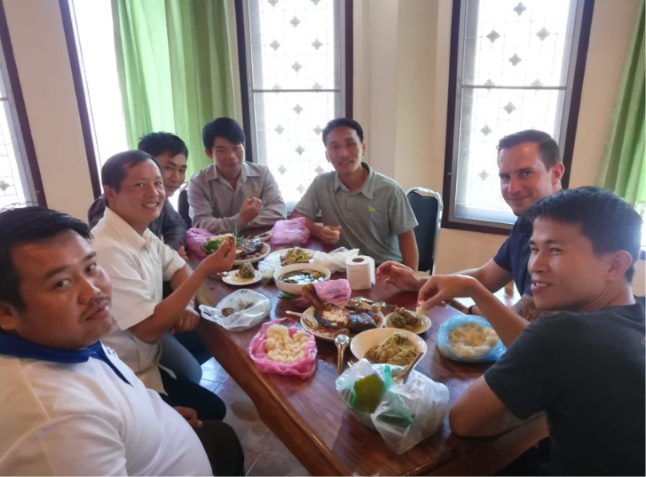
Laos has changed my life in every way possible. The country has become a throughline in who I am, embedding deep roots in the way I view the world, value my relationships, and treat others. This isn’t to say I arrived in Laos in search of principles or perspective—my upbringing was full of love and privilege, enabling me to pursue incredible opportunities. But Laos flipped a switch in my understanding of humanity, and it happened at a specific moment in time that would alter the course of everything to come.
When I descended into Wattay International Airport in June 2011, my future felt completely unknown, and I was filled with angst with the disjointed life I had left behind in the United States. I was recently engaged, disconnected from my doctoral program, and fearful of the year ahead alone in Laos. My family also seemed to be unraveling. My dad’s battle with alcoholism had flared just days before I left, ultimately causing a fracture in our relationship that would last for years and would never be completely healed.
But it was Laos that created the calm I needed to begin seeing clearly—and the quiet necessary to listen to what I needed to pursue. Over the next 14 months, Laos taught me how to see myself in a positive light, focus on helping the most vulnerable, and open myself to the power of being loved.

The biggest source of my fear about spending a year in Laos was the uncertainty of being accepted. It was a feeling I had known well throughout my teen and adult years, but this time it was different—it had to do with being an American. Knowing I came from a country that made Laos the most heavily bombed nation per capita filled me with a constant, underlying nausea about whether I would truly be welcomed. But it was more personal than that: I was also the son of a veteran who had waged war in the air and land of Southeast Asia in the ’60s and ’70s, a man who returned home carrying nightmares filled with death and fear.
After being named a Henry Luce Scholar in February 2011 and focusing on placement opportunities in Southeast Asia, my relationship with my dad began to shift in ways that would never fully heal. Though he could never fully articulate it, he was filled with his own fear. Intellectually, he may have known the region was safe and that I wasn’t heading into a war zone, but his lived experiences and memories rose to the surface. As the fracture points became more frequent, a breaking point came the night before I was set to leave for New York City for program orientation and it left an imprint on both of us that would take a significant amount of time to recover.
Over the course of time, there was healing between my dad and I through a shared experience in a part of the world that transformed us as individuals. While my dad became consumed throughout his life by nightmares of war and destruction, I was able to be enriched by seeing the highest potential in humanity and revitalized with a new outlook on life. It is not lost on me that I was not living in Laos during a gruesome conflict, but my own family’s legacy of war in the region was not a barrier to me developing lasting relationships. If anything, it was an outlet to share stories about my dad as a soldier and receive nothing but attitudes of sympathy and forgiveness from my Lao community. My beginnings in Laos were an opportunity to demonstrate how in one generation, my family’s presence in Southeast Asia could be rewritten from the darkness of war to the hope of community prosperity.

Conveying this evolution to my dad over time and sharing stories about my time in Laos seemed to give him a sense of inner peace. An understanding that communities were filled with love and calmness rather than the horror and fear that he witnessed as a young adult. There were conversations about us making a visit to Laos and its neighbors together and helping him rewrite a dark chapter of his history, but age and deteriorating health never made it possible. When he died in early 2024, I felt immediately grateful that he had been released from the demons that haunted him for most of his life. Relieved from the nightmares of tragedies witnessed and the anxieties that exacerbated his alcohol abuse. Relieved that his son had worked to alter his legacy with war.

Looking back now, it’s clear that Laos was exactly where I needed to be during such a pivotal moment in my life. The physical distance—being on the other side of the world—helped in ways, but it was the culture, food, people, and daily challenges that truly carried me through. It was my work supporting programs for survivors of unexploded ordnance, helping build lives beyond a war legacy so deeply tied to my own family. It was the countless happy hours with Lao colleagues in our office kitchen, filled with laughter and the release of worry. It was pushing myself into new challenges I had never imagined—immersing myself in a new language, saying “yes” more than “no,” and learning how to navigate waves of loneliness.

I am forever grateful for the way Laos opened its arms to me and held me during a time when I needed deep comfort. Like a bowl of warm noodle soup on a cool morning in the hills of northern Laos, the country offered comfort through a combination of simple, nourishing elements. Over the past 15 years, I’ve returned many times, and each visit helps me take a deep breath, put life into perspective, and recharge the part of myself that needs it most. I once asked a Lao friend why there seemed to be such little resentment towards Americans for all the harm that war continues to cause and he responded, “I suppose it is because we don’t live in the past and it cannot be changed. We don’t know what is ahead of us and all we truly know is what we experience in this moment. So, another Beer Lao?”
Since my dad’s death, I’ve worked to deliver that sense of ‘leave it in the past’ forgiveness delivered by Lao and I find it comes with challenges and excuses I make along the way. It has been more than three years since I’ve been in Laos–the absolutely longest absence since first arriving in June 2011–and I deeply believe the next big chapter in grieving my dad’s death will be closed when I return. A time to embody the meaning of forgiveness and turn a page. A time to watch the sunset on the Mekong, sip a cold Beer Lao, and let the current of the river carry away the past, just as it has for so many others.


